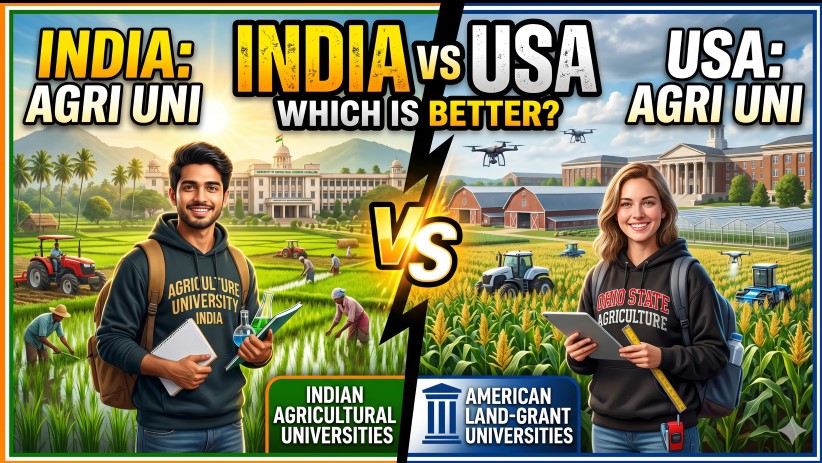
For decades, a Bachelor of Science in Agriculture was seen as a straightforward path to a government job in India. But as the global agricultural landscape shifts toward ag-tech, precision farming, and sustainable supply chains, students are looking westward.
If you are torn between staying in India and heading to the United States, you aren't just choosing a country; you are choosing an entirely different educational philosophy. A direct comparison of the ICAR BSc Ag syllabus vs US BS Agriculture syllabus reveals a fascinating shift: India focuses on securing the national food basket, while the US focuses on innovating the global agribusiness model.
Here is a deep, novel look at how these two powerhouse curriculums compare, and what it means for your future career.
The Core Philosophy: Uniformity vs. Customization
Before looking at the subjects, you must understand the structural DNA of both degrees.
The ICAR Approach (Regulated & Uniform): The Indian Council of Agricultural Research (ICAR) dictates a standardized syllabus for over 70 agricultural universities across India. Whether you study in Punjab or Tamil Nadu, your core subjects in Semester 1 will be exactly the same. It is designed to create a well-rounded foundation for public sector exams (like IBPS-AFO or NABARD) and grassroots extension work.
The US Approach (Liberal Arts & Land-Grant): The US BS Agriculture syllabus is largely shaped by the historical "Land-Grant University" system (like Iowa State, Purdue, or Texas A&M). It operates on a credit-based liberal arts model. You will spend your first year taking general education (writing, humanities, basic math) before diving into agriculture. More importantly, the curriculum is highly customizable based on your specific career goals.
Subject-by-Subject Breakdown: Where the Syllabi Diverge
When analyzing the ICAR BSc Ag syllabus vs US BS Agriculture syllabus, the differences fall into three distinct categories:
1. The Foundation Years (Semesters 1 & 2)
- ICAR: Hits the ground running. You immediately dive into Agronomy, Introductory Agriculture, Economic Botany, and Basic Agricultural Engineering. There is very little wiggle room.
- US: Focuses on breadth. You will take "Agri 101" (Introduction to Agriculture), but you will also take English Composition, Public Speaking, and elective sciences (like basic Chemistry or Biology, depending on your high school AP credits).
2. The Core Sciences (Semesters 3 to 5)
- ICAR: Exceptionally deep in traditional agrarian sciences. You will study Crop Physiology, Soil Science, Plant Breeding, Genetics, Agricultural Entomology, and Plant Pathology as mandatory, isolated blocks.
- US: Integrates the sciences. Instead of just "Soil Science," you might take "Soil-Plant-Water Relationships." Genetics is often paired with biotechnology lab work. You are also required to take courses in Agricultural Economics and Agricultural Communication, regardless of your major.
3. The Specialization Phase (Semesters 6 to 8)
This is where the ICAR BSc Ag syllabus vs US BS Agriculture syllabus comparison becomes the most drastic.
- ICAR: You will choose a "minor" or "elective" from a pre-approved list (e.g., Seed Technology, Mushroom Cultivation, or Agricultural Marketing), but the majority of your final year is still dedicated to compulsory courses like Farm Management, Post-Harvest Technology, and a mandatory Rural Agricultural Work Experience (RAWE).
- US: You declare a specific "Emphasis" or "Concentration" within your BS Ag degree. A US student isn't just an "Ag major." They are an Ag major with a concentration in Precision Ag Technology, Agricultural Business, Animal Science, or Sustainable Urban Farming. Your final semesters are almost entirely self-designed.
The Novel Shift: Traditional Agronomy vs. Ag-Tech Integration
The most significant, novel difference between the two syllabi is how they treat technology.
The ICAR syllabus treats technology as a tool within traditional subjects. You will learn about drip irrigation inside an Agronomy class, or learn about drone mapping as a sub-topic in Agricultural Engineering.
The US BS Agriculture syllabus treats technology as a discipline. In the US, it is common to take dedicated semester-long courses in:
- Geospatial Agriculture (GIS/GPS mapping)
- Precision Agriculture Hardware (Calibrating auto-steer tractors and variable-rate applicators)
- Agricultural Data Science (Using Python or R to analyze crop yield data)
- Agri-Fintech and Commodity Trading
If your goal is to work for companies like John Deere, Climate Corp, or Bayer Crop Science in a tech-adjacent role, the US syllabus has a distinct advantage.
Head-to-Head Comparison Table
| Feature | ICAR BSc Ag Syllabus (India) | US BS Agriculture Syllabus (USA) |
|---|---|---|
| Curriculum Control | Centralized by ICAR (Uniform nationwide) | Decentralized (Varies by university) |
| Structure | Rigid, heavily pre-decided | Flexible, credit-based, liberal arts integrated |
| Focus | Food security, traditional farming, public sector prep | Agribusiness, ag-tech, global market innovation |
| Practical Training | RAWE (Rural Agricultural Work Experience) - grassroots | Industry internships, undergraduate research assistantships |
| Elective Choices | Limited to traditional sub-disciplines | Massive (can include ag-law, ag-communications, drone tech) |
| Duration | 4 years (8 Semesters) | 4 years (usually 120-130 total credits) |
Career Outcomes: Which Syllabus Serves You Best?
Understanding the ICAR BSc Ag syllabus vs US BS Agriculture syllabus is useless without mapping it to your career goals.
Choose the ICAR BSc Ag route if:
- You want to crack Indian government exams (UPSC, State PSC, IBPS-AFO).
- You are passionate about working at the grassroots level with Indian farmers through NGOs or KVKs (Krishi Vigyan Kendras).
- You want a highly affordable, deeply respected degree in the Indian subcontinent.
Choose the US BS Agriculture route if:
- You want to work in multinational agribusiness management, supply chain logistics, or commodity trading.
- You want to specialize in Agricultural Biotechnology, Precision Farming, or Ag-Data Science.
- You plan to pursue a Master's degree (MS/PhD) at a top-tier global university and want to build a strong research portfolio early.
The Verdict
There is no "better" syllabus—there is only the syllabus that aligns with your ambition. The ICAR BSc Ag syllabus builds an unstoppable foundation in pure agricultural sciences, tailored for a country that relies heavily on agrarian economics. The US BS Agriculture syllabus, however, is built for the future of globalized, tech-driven food systems.
Evaluate your bank account, your career ambitions, and your willingness to adapt to a new educational culture, and the right choice will become clear.
Frequently Asked Questions (FAQs)
Can I do a Master's in the US after completing a BSc Ag under the ICAR syllabus?
Yes. An ICAR-accredited 4-year BSc Ag is widely accepted by US universities for admission into MS programs in Agriculture, Agronomy, or Food Science. However, you may need to take extra prerequisite courses (like advanced statistics or specific tech courses) depending on the US university's requirements.
Is the ICAR syllabus more difficult than the US syllabus?
"Difficult" is relative. The ICAR syllabus requires immense rote memorization, broad subject coverage, and rigorous theoretical examinations. The US syllabus requires continuous assessment (quizzes, projects, presentations), critical thinking, and self-directed learning.
Does the US BS Agriculture syllabus include field work like ICAR's RAWE?
Yes, but it looks different. Instead of a mandatory village stay (RAWE), US universities require "internships" or "co-ops." Students often spend a summer working on a large commercial farm, at a corporate agribusiness (like Cargill or Syngenta), or in a university research lab to gain their practical credits.
Are there scholarships available for a BS Agriculture in the US?
Yes, but they are highly competitive. Land-grant universities often offer in-state tuition waivers or specific scholarships for international students showing exceptional merit in agriculture or STEM fields.